
By Elmer Wenston, updated . 6 min read.
Legit IPTV services let you test them before you pay, show their full prices and refund terms in public, answer your questions, and take payment through methods that leave you a way to dispute a charge. A scam does the opposite: it rushes you, hides the details and asks for money you cannot get back. The twelve red flags below cover almost every bad experience people report.
Why IPTV attracts scams
IPTV services are sold online, often by small businesses, and a buyer cannot see the product until the login arrives. That gap is what scammers use. Some take payment and never send a login; others deliver a service that stops working after a few weeks and then vanish. The good news is that the warning signs are visible before you pay, if you know where to look. Whether a service is lawful is a separate question, answered in is IPTV legal in the USA.
12 red flags of an IPTV scam
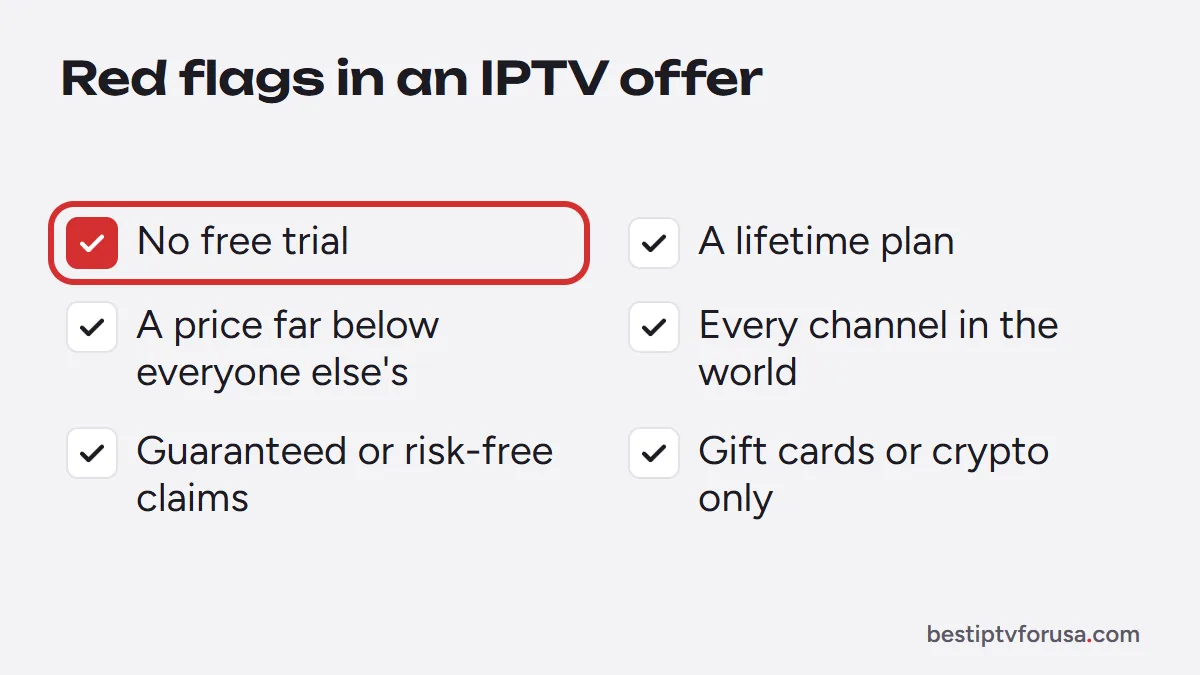
Red flags in the offer
- No free trial. A provider confident in its service lets you test it. “Pay first, test later” is the biggest warning sign of all.
- A “lifetime” plan. No business can promise service for life. If it closes next year, a lifetime payment is simply lost; our guide to the IPTV lifetime subscription explains what the word really covers.
- A price that is far below everyone else’s. Running servers and support costs money. A price that cannot cover them usually means the service will not last.
- Promises of “every channel in the world.” Huge numbers tell you nothing about whether the service plays well on your TV; our guide to IPTV channels explains what a real lineup includes.
- Wording that claims everything is guaranteed or risk-free. Honest providers describe what they offer and set out their terms. They do not need to oversell.
Red flags in how they sell
- Prices only by private message. If the total is not on the website, you cannot compare it, and it can change depending on who asks.
- Pressure to buy now. Countdown timers that restart and “last 3 spots” messages are designed to stop you from testing.
- No written refund policy. Or a page that says “all sales final” on a service you could not try.
- Reviews that all look the same. Dozens of five-star reviews posted the same week, in the same style, are a warning. In the US, the FTC’s rule banning fake reviews and testimonials targets exactly this practice.
Red flags in payment and support
- Gift cards, money transfer apps or crypto only. These methods are hard or impossible to reverse. A provider that refuses every payment method with dispute rights is limiting your options on purpose.
- No support before purchase. If nobody answers a simple question before you pay, nobody will answer after.
- No setup instructions and no copyright contact. A real provider shows you how to install its service on your device and publishes a way for rights holders to report a problem, usually a DMCA page.
Legit IPTV services vs scams: side by side
| What to check | Trustworthy provider | Likely scam |
|---|---|---|
| Trial | Free, on your own device, no card | None, or paid “test” |
| Plan length | Fixed periods, such as 3, 6 or 12 months | “Lifetime” or vague |
| Prices | Full totals on the website | “Message us for price” |
| Refunds | Written policy with a time limit | None, or “all sales final” |
| Payment | Card, Apple Pay, Google Pay; crypto as an option | Gift cards or crypto only |
| Support | Answers before and after you buy | Silent until you pay |
| Device help | Setup guides per device | “Works on everything” |
| Copyright contact | DMCA page | None |
For a fuller version of this table, with what to test during a trial, see our checklist on how to choose an IPTV service.
How to pay for IPTV safely
For the device side, such as modified apps and logins, see Is IPTV safe to use?.
The way you pay decides what you can do if something goes wrong.
- Credit card. The FTC explains that you can dispute a charge for something not delivered as agreed, and that your letter should reach the card issuer within 60 days after the first bill with the error was sent to you (FTC: Using credit cards and disputing charges).
- Apple Pay or Google Pay. These wallets pay with a card stored on your phone, so the card’s dispute options generally still apply; check your issuer’s terms.
- Debit card. Protections exist but differ from credit cards. Ask your bank how its dispute process works before you rely on it.
- Crypto. According to the FTC, “cryptocurrency payments typically are not reversible” and do not come with the legal protections cards have (FTC: What to know about cryptocurrency and scams). It can be convenient with a provider you already know; it is a poor choice with one you have never tested.
BestIPTVforUSA accepts Apple Pay, Google Pay, credit and debit cards through a secure payment link, and crypto for those who prefer it. We suggest new customers start with the free trial and pay by card or wallet.
Before you pay: a 5-minute check
Still deciding whether IPTV suits your home at all? Our guide Is IPTV worth it? weighs the pros, the downsides and the real costs.
Run through this list with any provider:
- Find the trial and start it on the device you will actually use.
- Find the refund page and note the time limit.
- Find the full price for your number of screens on the plans page or its equivalent, and check whether the plan renews automatically.
- Send support one question and time the reply.
- Look for setup guides for your device and a copyright contact.
If any step fails, keep looking. Our guide to what IPTV costs helps you tell a fair price from one that is too good to be true.
What to do if you have been scammed
Act quickly; time limits apply.
- Write to the provider once, in writing, and ask for a refund under its policy. Keep a copy.
- Gather proof: the receipt, the order email, screenshots of the offer, and your chats.
- Contact your card issuer or bank and dispute the charge. With a credit card, mind the 60-day window the FTC describes.
- Report it to the Federal Trade Commission at ReportFraud.ftc.gov.
- Change any password you reused on the provider’s site, and stop using the app or link it gave you.
If you paid in crypto, contact the platform you used to send it straight away, but be prepared that the payment may not be recoverable.
How BestIPTVforUSA handles this
We would rather show you than promise. You get a 24-hour trial on one screen with no card, prices from $30 for three months published on the site, plans that never renew on their own, support by email and chat day and night, and a refund within 48 hours if the service does not work on your device and support cannot fix it. New to IPTV? Read what IPTV is and how it works first.
Questions people ask
How can I tell if an IPTV service is legit?
Look for a free trial, published prices and refund terms, a support team that answers before you buy, setup guides for your device and a copyright (DMCA) contact. A service missing several of these is a risk.
Are lifetime IPTV subscriptions a scam?
Treat them with great caution. No one can promise a service for life, and if the provider closes, the money is gone. A plan with a fixed end date, even a long one, is easier to judge.
Can I get my money back from an IPTV provider?
First ask the provider under its refund policy. If you paid by credit card and the service was not delivered as agreed, the FTC explains how to dispute the charge with your card issuer; your dispute letter should reach the issuer within 60 days of the first bill with the error.
Is paying for IPTV with crypto safe?
Crypto can be convenient, but the FTC warns that crypto payments typically are not reversible and do not come with the legal protections cards have. Use it only with a provider you have already tested.
Where can I report an IPTV scam?
You can report fraud to the Federal Trade Commission at ReportFraud.ftc.gov, and contact your card issuer or bank if you paid by card.

Elmer Wenston writes the BestIPTVforUSA guides on IPTV setup, player apps and devices.