
By Elmer Wenston, updated . 5 min read.
If you are working out how to start an IPTV business in 2026 without operator-scale money, the practical answer is to resell an existing service. You buy credits from a supplier, create customer lines from a reseller panel, set your own prices and handle your customers’ setup and support. Building your own platform is a different business, with servers, streaming software and content agreements. This guide explains both routes, how the reseller model works, a simple business plan with margins and what it takes to run it properly.
Two ways to start an IPTV business
| Build your own platform | Resell an existing service | |
|---|---|---|
| What you run | Servers, streaming software, apps, guide data | A reseller panel and your customer relationships |
| Content | Agreements with the owners of each channel and title | Provided by your supplier |
| Starting cost | Operator-scale investment | A first block of credits and a sales channel |
| Time to start | A long build and negotiation phase | As soon as the supplier opens your panel |
| Your main job | Engineering, rights and operations | Sales, setup help and support |
The platform route is what cable operators and large streaming companies do. Equipment makers and middleware vendors sell to them, so guides written for operators answer a different question. For an individual or a small team, the reseller route is the realistic one, and the rest of this guide covers it.
How the reseller route works
A reseller works from a panel, a private website where you manage your customers. The model has three parts:
- Credits. You buy credits from your supplier in advance. The supplier sets what one credit buys, for example one month of service for one line; get that rule in writing.
- Lines. For each customer, you create a line in the panel: a login for one or more screens, valid for the period you choose. The panel deducts the matching credits.
- Trials and renewals. You create short test lines for new customers and extend existing lines when they renew.
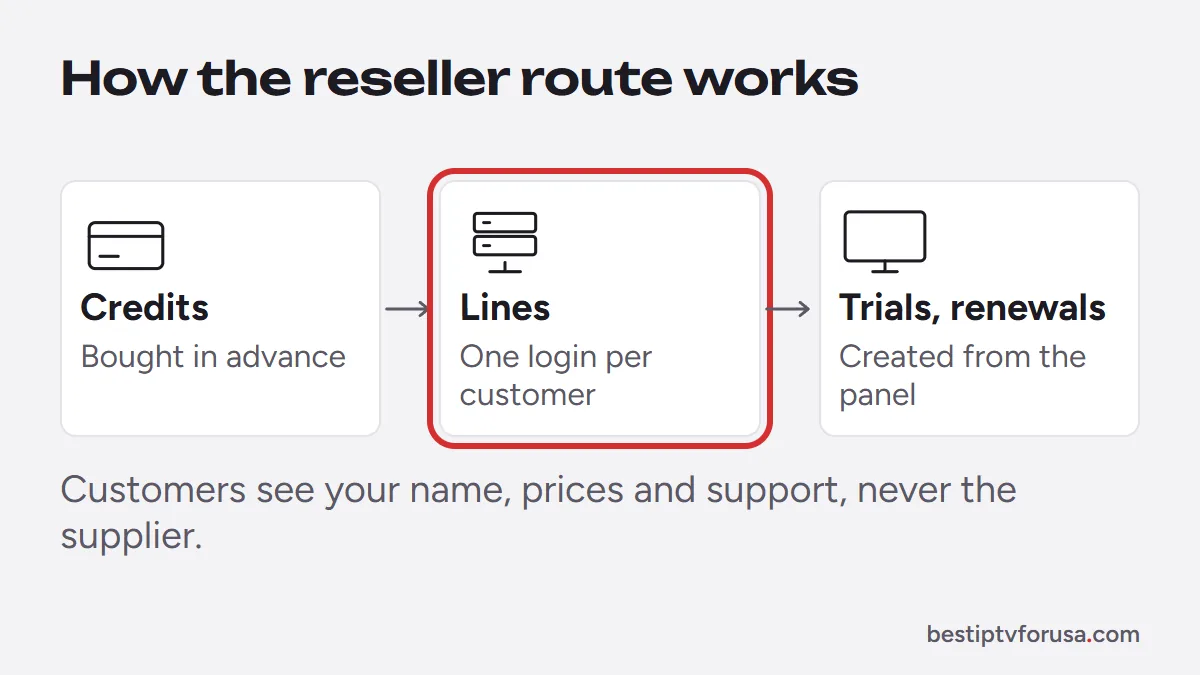
Your customers never see the supplier. They see your name, your prices and your support. In return, you depend on the supplier’s service quality, which is why choosing one carefully matters more than anything else in this business. Our IPTV reseller program page shows how our own panel and credits work.
Your IPTV business plan: costs, prices and margins
The Small Business Administration describes a business plan as “a roadmap for how to structure, run, and grow your new business” (SBA: Write your business plan). For a reseller, the plan fits on one page:
- Cost per line: what the credits for one customer-month or customer-year cost you.
- Retail price: what you charge for the same period.
- Gross margin: the difference, before your own costs.
- Your fixed costs: website, payment fees, phone, tools.
- Your time: setup and support hours per customer.
A worked example with round numbers shows the logic. If the credits for a one-year line cost you $40 and you sell that year for $75, your gross margin is $35 per customer per year. With 40 customers, that is $1,400 a year before payment fees, website costs and your time. Replace these numbers with your supplier’s real credit prices and your own retail prices; they are an illustration, not market data.
Two things decide whether the plan works: how many customers renew, and how much support time each one needs. A customer who renews every year with no problems is worth far more than a cheap sale that comes back with questions every week.
The work behind each customer
Resellers are judged on support. Each new customer needs:
- Setup help on their device: a Fire TV, a smart TV, an Apple TV, an Android box or a phone, each with its own app and login type.
- Quick answers when a channel freezes, the guide is empty or a login fails.
- Renewal reminders before the line expires, so the service does not stop by surprise.
- Clear refund rules, written before they pay.
Our setup guides and troubleshooting articles, such as the IPTV not working guide, are the kind of material your customers will need; many resellers send them links rather than writing their own.
Running it as a real business
Knowing how to start an IPTV business also means knowing the paperwork: an IPTV reseller is a small business like any other. The SBA’s business guide covers the basic steps: planning, choosing a business structure, registering the business name with your state, and getting federal and state tax ID numbers (SBA business guide). In practice:
- Register the business and keep records of sales, refunds and credit purchases.
- Use payment methods with dispute rights, such as cards, so customers can trust you.
- Publish your terms, including prices, refund window and what happens at renewal.
- Publish a contact that answers, and a way for rights holders to report a problem.
On content, the rule is simple: only resell a supplier that has the right to distribute what it streams, and stay away from offers that cannot explain where their content comes from. For a plain-English overview, see is IPTV legal in the USA.
Choosing a supplier for your panel
Before you buy credits, check five things:
- A trial line you can test on your own devices at a busy time.
- Support for resellers, not only for end users: someone who answers you quickly when a customer has a problem.
- Written credit prices and rules, including minimum orders and what one credit covers.
- Panel features: trials, renewals, screen counts and device activation by MAC address or device ID.
- A track record you can check, and no warning signs from our IPTV scam red flags list.
A supplier that passes these five checks is one you can support day to day. To see how ours works, start with the IPTV reseller program, and compare it with the checklist in how to choose an IPTV service.
Questions people ask
How can I become an IPTV provider?
Building a platform means servers, streaming software and agreements with the owners of the content, which is a job for operators. Most people who start an IPTV business become resellers instead: they buy credits from a supplier and sell lines to their own customers.
Can I do IPTV myself?
You can run the customer side yourself as a reseller: selling, setup help and support. The streams, servers and content agreements stay with the supplier you resell.
How much does it cost to start an IPTV business?
As a reseller, the main starting cost is your first block of credits, plus a website or other sales channel and your time. Credit prices and minimum orders depend on the supplier, so ask for them in writing before you commit.
How do I find customers?
Start with people you can help in person, then a simple website and local word of mouth. Clear prices, a free trial and fast support bring repeat customers; avoid spam and misleading ads.

Elmer Wenston writes the BestIPTVforUSA guides on IPTV setup, player apps and devices.